

SEO for Roofers: Guide to SEO for Roofing Companies to Get More Roofing Leads
When a homeowner discovers a roof leak, notices missing shingles, sees signs of storm damage, or realizes that their roof needs to be replaced, they usually don’t wait around for a roofing company to find them. They search Google.
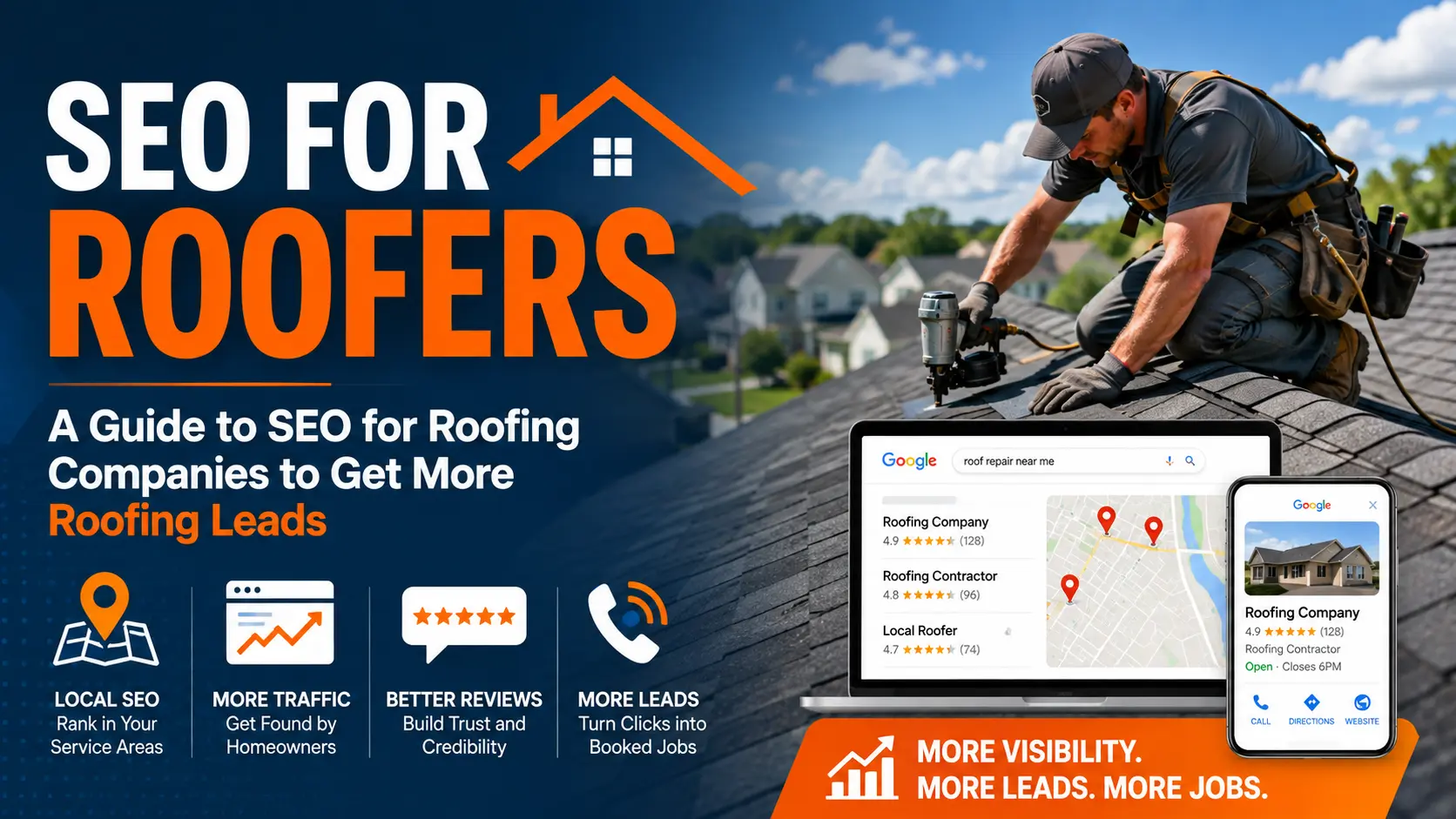
They might search for “roofers near me,” “roof repair company,” “roof replacement contractor,” or something as simple as “roof repair in [city].” Within seconds, Google gives them a list of roofing companies, Maps listings, reviews, and websites to choose from.
If your roofing company isn’t showing up when potential customers are searching, your competitors are getting those calls instead.
This is where SEO for roofing companies becomes important. A strong online presence can help your business appear when homeowners are actively looking for roofing services in your area. But roofing SEO isn’t just about getting your website to rank at the top of Google’s organic results.
There are several places where a roofing company needs to be visible.
That includes Google Search, the Google Maps/Local Pack, service-specific searches such as roof repair and roof replacement, and location-based searches from people looking for roofing contractors in specific cities or neighborhoods.
It also involves the things that influence whether someone chooses your company after finding you. Your Google reviews, website content, local citations, backlinks, and overall online reputation can all play a role.
Behind the scenes, there is also the technical side of SEO. Your website needs to be easy for search engines to crawl and understand, fast enough to provide a good experience, mobile-friendly, and structured around the services and locations you actually serve.
Then there is the content side.
Please target the right roofing keywords and create useful pages that answer what potential customers are searching for.
A page about roof repair, for example, should be designed to attract people looking for repair services rather than trying to rank every page for the same broad keyword.
A good roofing SEO strategy also considers what happens after someone lands on your website. Getting visitors is only part of the job.
Your website should make it easy for potential customers to call, request an estimate, fill out a contact form, or take another step toward hiring you.
And search is changing.
Homeowners are increasingly getting answers through AI-powered search experiences alongside traditional Google results.
That means roofing companies need to build an online presence that is useful, trustworthy, locally relevant, and easy for both search engines and AI systems to understand.
Ultimately, the goal of SEO for roofing isn’t simply to generate more website traffic.
The real goal is to get your roofing company in front of homeowners who are ready to take action, and turn that visibility into qualified roofing leads, phone calls, estimate requests, and booked jobs.
In this guide, I’ll break down how roofing company SEO works, what you need to focus on, which strategies can help you compete in local search, and how to build a system that can consistently bring more roofing leads from Google.
What Is SEO for Roofers?
SEO for roofers is the process of improving a roofing company’s website, Google Business Profile, content, reputation, and overall online presence so the business can appear when people search for roofing services.
In simple terms, it’s about making sure your roofing company is easy to find when a potential customer needs you.
For example, someone might search for “roof repair near me,” “roofing contractor in [city],” or “roof replacement company.” If your business is properly optimized, you have a better chance of appearing in those searches and getting the customer to contact you.
However, roofing SEO involves much more than adding keywords to a website.
A successful roofing company SEO strategy usually includes several different areas:
- Local SEO: Optimizing your Google Business Profile and other local listings so you can appear in Google Maps and local search results.
- On-page SEO: Optimizing service pages, location pages, headings, titles, images, and other elements on your website.
- Technical SEO: Making sure your website is fast, mobile-friendly, easy for search engines to crawl, and technically sound.
- Keyword research: Finding the terms potential customers actually use when searching for roofing services.
- Content marketing: Creating useful content that answers common roofing questions and targets relevant searches.
- Link building: Earning links from relevant and trustworthy websites to strengthen your site’s authority.
- Reputation management: Building and maintaining positive reviews across Google and other important platforms.
- Conversion optimization: Making it easy for visitors to call your business, request an estimate, or submit a lead form.
- AI and search visibility: Creating clear, useful information that can potentially be surfaced in newer AI-powered search experiences as search behavior continues to change.
The important thing to understand is that all of these pieces work together.
You could have a great-looking website, for example, but if your Google Business Profile is poorly optimized and you have very few reviews, you may still struggle to attract local customers.
Likewise, ranking for a lot of keywords doesn’t automatically mean you’ll get more jobs. The keywords need to attract people who actually need roofing services.
That’s why good roofing SEO focuses on visibility, trust, and conversions, not just rankings.
How Roofing SEO Is Different From General SEO
At first, roofing SEO might seem similar to SEO for any other type of business. The basic principles are the same, but roofing has some characteristics that make local and service-based SEO especially important.
First, roofing is highly local.
Most homeowners aren’t looking for a roofing company hundreds of miles away. They want someone who serves their city, neighborhood, or nearby area.
This makes local SEO for roofers one of the most important parts of a roofing marketing strategy. Your Google Business Profile, local landing pages, citations, reviews, and location-based content can all help your business compete for local searches.
Second, many roofing searches have strong purchase intent.
Someone searching for “how long does a roof last?” may only be doing research. But someone searching for “roof replacement company near me” is much closer to contacting a contractor.
Understanding this difference helps you prioritize the searches that are more likely to generate leads.
Third, roofing emergencies can create sudden demand.
A major storm can damage hundreds or thousands of roofs in an area. Homeowners may immediately search for terms such as “emergency roof repair,” “storm damage roof repair,” or “roofer near me.”
Being visible at that moment can make a huge difference.
Google Maps is also extremely important for roofing companies.
When someone searches for a local roofer, Google often shows a map with nearby businesses before or alongside the traditional organic results.
A strong Google Business Profile, positive reviews, accurate business information, and local SEO can help your company compete for this valuable visibility.
Reviews matter for another reason: roofing is a high-trust purchase.
A homeowner is not likely to hire a roofing contractor simply because the company has a nice website. They want to know that other customers have had a good experience.
A strong review profile can give potential customers the confidence they need to make that first call.
Another major opportunity comes from service + location searches.
Instead of targeting only a broad term like “roofing company,” you can build visibility around searches such as “roof repair in [city],” “roof replacement in [city],” “metal roofing contractor in [city],” and many other combinations.
When you consider different roofing services, cities, neighborhoods, and customer needs, there can be many relevant searches to target.
Finally, roofing jobs can have a relatively high customer value.
A single roof replacement can be worth thousands of dollars to a contractor. That means even a small number of additional qualified leads can have a meaningful impact on revenue.
For that reason, investing in roofing contractor SEO isn’t simply about getting more visitors to your website. It’s about reaching homeowners at the right time, in the right location, with the right service, and giving them a clear reason to choose your company.
Why SEO Is Important for Roofing Companies
For a roofing company, getting in front of potential customers at the right time can make a huge difference.
Most homeowners don’t think about hiring a roofer until they actually have a problem. They may notice a leak, find missing shingles after a storm, or realize that their roof is getting old and needs to be replaced.
When that happens, they often turn to Google.
This is why investing in SEO for roofing companies can be valuable. Instead of only trying to reach people through traditional advertising, SEO helps your business become visible when homeowners are already searching for the services you offer.
Reach Homeowners When They Need a Roofer
One of the biggest advantages of SEO is that it can put your business in front of people who already have a roofing problem or are actively looking for a contractor.
Think about searches such as:
- “roof repair near me”
- “roof leak repair”
- “roof replacement”
- “emergency roofer”
- “storm damage roof repair”
These aren’t just informational searches. Many of them come from people who may be ready to call a roofing company.
If your website or Google Business Profile appears when they make that search, you have an opportunity to turn that search into a phone call or estimate request.
This is one reason roofing SEO services focus heavily on service-specific and local searches. The goal isn’t to rank for random traffic. It’s to show up for searches that can lead to real roofing jobs.
Generate Consistent Roofing Leads
SEO can also help create a more consistent source of leads over time.
With paid advertising, you generally pay to get your business in front of potential customers. When you stop spending on the ads, the traffic and leads generated from those ads can drop quickly.
SEO works differently.
If you build strong rankings for important roofing searches, those rankings can continue bringing visitors and potential leads even when you’re not paying for every individual click.
That doesn’t mean SEO is free.
You still need to invest in things such as content creation, technical improvements, local SEO, link building, tools, and potentially professional roofing company SEO services. Rankings also need to be maintained because competitors are constantly trying to improve their own visibility.
But the economics can be different from paying for every visitor.
A well-optimized page that ranks for a valuable search can potentially generate clicks and leads month after month without requiring you to pay for each click individually.
Build Long-Term Visibility
Another reason I consider SEO valuable for roofing companies is that it isn’t limited to one position in Google’s search results.
A strong roofing SEO strategy can help your business build visibility across several parts of search.
This can include:
- Google organic results — The traditional search listings below the paid ads.
- Google Maps — Where homeowners can discover nearby roofing companies.
- Local Pack — The local business results that often appear prominently for searches with local intent.
- Featured snippets — Search result features that provide a direct answer to certain questions.
- Image search — Useful for showcasing completed roofing projects and other visual content.
- AI-generated search results — Newer search experiences that can use information from websites and other online sources to answer questions.
You don’t necessarily need to rank everywhere at once.
The point is to build a broader online presence so your company has more opportunities to be discovered when someone is researching roofing services.
Over time, this can make your brand more familiar to homeowners in the areas you serve.
Reduce Dependence on Lead Generation Platforms
Many roofing companies also rely on third-party lead generation websites and marketplaces.
These platforms can be useful, especially when a company needs leads quickly. But there is a downside: you may be paying for leads that are shared with other roofing contractors.
In some cases, several companies may receive the same homeowner’s information and compete to win the job.
That can make the lead more expensive and the sales process more competitive.
Building your own organic search visibility gives you another way to generate leads directly.
When a homeowner finds your website or Google Business Profile through a search such as “roof replacement contractor near me,” they are coming directly to your business rather than being routed through a lead marketplace.
You still shouldn’t expect SEO to replace every other marketing channel. Paid advertising, referrals, social media, and lead platforms can all have their place.
But a strong roofing company SEO strategy can help reduce your dependence on any single source of leads and give you an online asset that can continue working for your business over the long term.
How Roofing SEO Works
I like to think of roofing SEO as a simple process rather than a collection of random SEO tactics.
The basic journey looks like this:
Search → Visibility → Website/Maps → Trust → Lead → Estimate → Job
A homeowner starts by searching for something they need. Your goal is to make your roofing company visible for that search, give the person useful information, build enough trust for them to consider your company, and make it easy for them to contact you.
From there, the lead can turn into an estimate and, eventually, a paying roofing job.
Here’s how each step works.
Step 1 — Target the Right Searches
The first step is understanding what your potential customers are actually searching for.
Someone looking for a roofer might search for “roof repair near me,” while another person might search for “roof replacement company in [city].” Someone who has just experienced storm damage may search for “storm damage roof repair.”
These searches have different levels of intent.
As part of your roofing SEO strategy, you want to identify the searches that are relevant to your services, locations, and ideal customers.
This is where keyword research comes in.
You don’t need to target every possible keyword. Instead, focus on roofing keywords that have a clear connection to the services you provide and the areas you serve.
Step 2 — Create Relevant Pages
Once you know what people are searching for, your website needs pages that can actually answer those searches.
For example, if you offer roof repair and roof replacement, you could have dedicated pages for each service instead of trying to rank one generic homepage for everything.
You might have pages such as:
- Roof repair
- Roof replacement
- Emergency roofing
- Storm damage repair
- Commercial roofing
- Metal roofing
- Roof inspections
You can also create location-specific pages when you genuinely serve those areas.
For example, a roofing company serving multiple cities might create useful pages for “roof repair in [City]” and “roof replacement in [City].”
The important part is that each page should provide real value. Simply creating dozens of pages with slightly different city names isn’t a good long-term approach.
Step 3 — Optimize for Local Search
Roofing is a local business, so showing up in local search is extremely important.
This means optimizing your Google Business Profile, keeping your business name, address, phone number, and other information accurate, and building relevant local citations.
Your website should also clearly explain where you operate and which services you provide.
Reviews are another major part of local visibility.
When someone compares roofing companies in Google Maps or the Local Pack, the number and quality of reviews can influence which businesses they consider.
A strong local SEO for roofers strategy brings all of these elements together to help your business become more visible in the areas you serve.
Step 4 — Build Authority and Trust
Getting visibility is only part of the process.
A homeowner still needs a reason to trust your company.
Your website should clearly explain who you are, what services you offer, where you work, and why customers should choose you.
Project photos, customer reviews, warranties, certifications, years of experience, insurance information, and clear contact details can all help build confidence.
SEO also involves building authority beyond your own website.
Relevant backlinks from local organizations, industry websites, suppliers, news publications, business directories, and other trustworthy sources can help strengthen your website’s authority.
The goal isn’t to collect as many links as possible. It’s to build a reputation that makes sense for a real roofing business.
Step 5 — Convert Visitors Into Leads
Finally, you need to turn your search visibility into actual leads.
There’s little value in ranking well if visitors arrive at your website and don’t know what to do next.
Your website should make the next step obvious.
Depending on your business, that could mean:
- Calling your roofing company
- Requesting a free estimate
- Booking a roof inspection
- Filling out a contact form
- Requesting emergency roof repair
- Sending photos of the damage
Your phone number should be easy to find, especially on mobile devices.
Your forms should be simple and only ask for information you actually need.
Clear calls to action can also make a difference. Instead of leaving visitors to figure out what to do, tell them exactly what the next step is.
This is where conversion optimization becomes an important part of roofing SEO.
Ultimately, the goal isn’t simply to get your roofing company to rank.
The goal is to move a homeowner through the entire journey, from searching for a roofer to finding your business, trusting you, contacting you, getting an estimate, and eventually hiring you.
That’s what turns SEO into a lead-generation system rather than just a traffic strategy.
Roofing Keyword Research
One of the first things I would focus on when working on SEO for a roofing company is keyword research.
A common mistake is to build the entire SEO strategy around one broad keyword such as “roofer.”
That keyword may be relevant, but it doesn’t tell you much about what the person actually wants. Someone searching for “roofer” could be looking for a roofing contractor, researching roofing as a career, or simply trying to understand what the word means.
Many other searches are much more specific.
For example, someone searching for “emergency roof repair near me” has a very different intent from someone searching for “how long does a roof last?”
That’s why I recommend organizing roofing keywords into different groups based on what the searcher wants.
Core Roofing Keywords
These are the broad terms that describe your business and industry.
Examples include:
- roofing company
- roofing contractor
- roofer
- roofing services
- roofing company near me
These keywords are useful for your homepage, main service pages, and other important parts of your website.
However, I wouldn’t rely on these terms alone.
They are often competitive and don’t always tell you exactly what service the person needs.
The real opportunity comes from combining these broad keywords with service, location, and problem-based searches.
Service-Based Roofing Keywords
Service-based keywords describe the specific roofing service someone is looking for.
Some examples include:
- roof repair
- roof replacement
- roof installation
- emergency roof repair
- storm damage roof repair
- metal roofing
- flat roof repair
- commercial roofing
- shingle roof replacement
These keywords are particularly valuable because they often have strong commercial intent.
For example, someone searching for “roof replacement” may already know they need a new roof and could be comparing contractors.
Instead of creating one generic page targeting every roofing service, I would create dedicated pages for the major services your company actually provides.
This gives each page a clear purpose and makes it easier to match your content with the searcher’s intent.
It also creates opportunities for more specific strategies such as roof repair SEO and roof replacement SEO.
Location-Based Keywords
Roofing is a local business, so location-based keywords should be a major part of your strategy.
Examples include:
- roofing company in [city]
- roofer in [city]
- roof repair [city]
- roof replacement [city]
- roofing contractor [city]
You can replace “[city]” with the locations your company actually serves.
For example, a roofing company in Dallas might target searches such as “roof repair Dallas” or “roofing contractor in Dallas.”
You can also consider neighborhoods, suburbs, and nearby service areas when they are genuinely relevant to your business.
However, avoid creating hundreds of nearly identical location pages just to target every possible city. Each location page should provide useful, locally relevant information.
Problem-Based Keywords
People don’t always search for a specific roofing service.
Sometimes they search because they’ve noticed a problem and don’t know exactly what service they need.
Examples include:
- roof leaking
- water coming through ceiling
- missing roof shingles
- storm damaged roof
- hail damage roof
- roof leak repair
These searches can be especially valuable because they often happen when a homeowner is dealing with an immediate problem.
For example, someone searching “water coming through ceiling” may not search for “roof repair” at first. But if the problem is caused by a damaged roof, that person may soon need a roofing contractor.
Creating useful content around these problems can help you reach potential customers earlier in their decision-making process.
Informational Keywords
Not every potential customer is ready to hire a roofer immediately.
Some people are still researching their options or trying to understand what is happening with their roof.
That’s where informational keywords come in.
Examples include:
- how long does a roof last?
- how much does a roof replacement cost?
- how often should you replace a roof?
- signs you need a new roof
- how to choose a roofing contractor
These searches can be targeted through blog posts, guides, FAQs, and other helpful content.
For example, a detailed article explaining the signs of an aging roof could attract a homeowner who isn’t ready to contact a contractor yet.
Later, when that homeowner realizes they need an inspection or replacement, your company may already be familiar to them.
This is why I wouldn’t treat informational keywords as useless simply because they don’t always generate an immediate lead.
They can help build top-of-funnel traffic, authority, and trust while supporting your more commercial pages.
Don’t Focus Only on Search Volume
When researching roofing keywords, it’s tempting to choose keywords based entirely on search volume.
I think that’s a mistake.
A keyword with 500 monthly searches isn’t necessarily more valuable than one with 50 searches.
If those 50 searches come from people who are actively looking for a roofing contractor, they could potentially generate more business.
For a roofing company, search intent matters just as much as search volume.
The best keyword strategy usually combines broad industry terms, service-specific searches, location-based searches, problem-based searches, and informational topics.
That gives your website multiple ways to appear in search while helping you reach homeowners at different stages of the buying process.
Ultimately, good keyword research isn’t about finding the biggest list of keywords possible.
It’s about finding the searches that your potential customers are actually using and creating the right content or page to answer each one.
Commercial-Intent vs Informational Keywords
|
Keyword Type |
Example |
Intent |
|---|---|---|
|
Transactional |
roofing company near me |
Very high |
|
Commercial |
best roofing company in [city] |
High |
|
Service |
roof replacement [city] |
Very high |
|
Problem |
roof leaking |
High |
|
Informational |
how long does a roof last |
Low–medium |
Create the Right Website Structure for a Roofing Company
A roofing company’s website should make it easy for both search engines and potential customers to understand what the business offers.
Homepage
│
├── Roofing Services
│ ├── Roof Repair
│ ├── Roof Replacement
│ ├── Roof Installation
│ ├── Emergency Roofing
│ ├── Storm Damage Roofing
│ ├── Metal Roofing
│ └── Commercial Roofing
│
├── Service Areas
│ ├── Roofing in [City]
│ ├── Roofing in [City]
│ └── Roofing in [City]
│
├── About
├── Projects
├── Reviews
├── Blog
└── Contact
One mistake I often see is trying to put every roofing service on a single generic “Roofing Services” page.
That may look simple, but it can limit your SEO opportunities.
If you offer roof repair, roof replacement, emergency roofing, commercial roofing, and other services, each major service deserves enough space to explain what you actually provide.
Why Every Major Roofing Service Needs Its Own Page
A dedicated service page gives you an opportunity to target specific searches and provide information that is directly relevant to the customer.
For example, someone searching for roof repair probably doesn’t want to land on a page that gives equal attention to roof replacement, commercial roofing, and every other service you offer.
They want information about roof repair.
A dedicated roof repair page can explain:
- What types of roof problems you repair
- Common signs that a roof needs repair
- Your roof repair process
- Types of roofs you work on
- Areas you serve
- What customers can expect
- How to request an inspection or estimate
The same approach can be used for services such as roof replacement, emergency roofing, metal roofing, commercial roofing, and storm damage repair.
It also gives Google a much clearer understanding of what each page is about.
For example, instead of expecting one “Roofing Services” page to rank for everything, you could have:
Homepage → Roofing Services → Roof Repair
Homepage → Roofing Services → Roof Replacement
Homepage → Roofing Services → Storm Damage Roofing
Homepage → Roofing Services → Commercial Roofing
This creates a much cleaner website structure and gives you more opportunities to target relevant roofing keywords.
It can also improve the user experience because visitors can quickly find the specific service they need.
Create Service + Location Landing Pages
If your roofing company serves multiple cities or service areas, you can also combine your services with locations.
For example:
- Roof Repair in Dallas
- Roof Replacement in Houston
- Emergency Roofing in Phoenix
- Storm Damage Roofing in Austin
- Commercial Roofing in Fort Worth
These pages can target searches that combine a service with a specific location.
For example, someone searching for “roof repair Dallas” has a very clear idea of both the service they need and where they need it.
A well-created service + location page can provide useful information about that service while explaining how your company serves customers in that particular area.
However, there is an important warning here.
Don’t create hundreds of thin, nearly identical location pages just to target different cities.
Changing “Dallas” to “Houston” and leaving everything else the same doesn’t create much value for users.
It can also make your website look like it was created purely for search engines rather than homeowners.
Instead, create location pages for areas that are genuinely important to your business and make them useful.
Where appropriate, include local information, the services you provide there, examples of work, relevant customer reviews, service-area details, and other information that makes the page genuinely useful to someone in that location.
The goal isn’t to create as many pages as possible.
The goal is to create the right pages for the right searches.
A well-organized roofing website might therefore have a structure like:
Homepage
→ Roofing Services
→→ Roof Repair
→→ Roof Replacement
→→ Storm Damage Roofing
→→ Emergency Roofing
→→ Commercial Roofing
→ Service Areas
→→ Dallas
→→ Houston
→→ Phoenix
→ Location + Service Pages
→→ Roof Repair in Dallas
→→ Roof Replacement in Houston
→→ Emergency Roofing in Phoenix
This type of structure gives your website a clear hierarchy and makes it easier to connect your services, locations, and content.
More importantly, it helps you build a website around how homeowners actually search for roofing services rather than trying to force every keyword onto a handful of pages.
Local SEO for Roofers
For most roofing companies, local SEO should be one of the biggest parts of the overall SEO strategy.
A homeowner usually isn’t looking for the “best roofing company in the country.” They want a reliable roofer who can come to their home and solve the problem.
That makes location extremely important.
Google uses factors such as relevance, distance, and prominence when determining local search results. Complete business information, reviews, links, and other signals can all help Google understand and evaluate a local business.
The good news is that there are several things a roofing company can do to improve its local presence.
Optimize Your Google Business Profile
Your Google Business Profile is one of the most important assets in local SEO for roofers.
It helps your business appear on Google Search and Google Maps and gives potential customers important information about your company.
I would start by making sure every important part of the profile is complete and accurate.
This includes:
- Business name: Use your real business name and avoid adding extra keywords just to manipulate rankings.
- Primary category: Choose the category that best represents your main business.
- Secondary categories: Add relevant additional categories where they accurately describe your services.
- Business description: Clearly explain what your roofing company does and the areas you serve.
- Services: Add the roofing services you actually provide, such as roof repair, roof replacement, storm damage repair, or commercial roofing.
- Service areas: Specify the areas your company genuinely serves.
- Phone number: Use a reliable business phone number that customers can reach.
- Website: Link to your official website.
- Hours: Keep your regular and special hours accurate.
- Photos: Add high-quality photos of your team, trucks, office, completed roofs, and projects.
- Videos: Where appropriate, upload useful videos showing your work and company.
- Business attributes: Complete any relevant attributes available for your business.
- Posts: Use Google Business Profile posts when you have useful updates, offers, projects, or other information to share.
I wouldn’t treat the profile as something you set up once and forget.
Keep the information updated as your business changes, add new project photos, respond to customers, and make sure the information customers see on Google matches what’s on your website.
Google itself recommends keeping Business Profile information complete and accurate and using photos, videos, and customer reviews to help customers understand the business.
Get More Google Reviews
Reviews are important for roofing companies because homeowners are trusting you with a major investment.
Before calling a roofer, many people will look at the company’s rating and read what previous customers have said.
That’s why I would make getting genuine customer feedback part of the normal process after completing a roofing job.
For example, after finishing a project, you can send the customer a simple review request with a direct link to your Google review page.
You can also train your office or sales team to ask satisfied customers for a review once the job has been completed.
A simple process might look like:
Job completed → Customer is satisfied → Send review request → Customer leaves review
Don’t try to manufacture reviews or ask people to write something that isn’t true.
Fake reviews can damage your reputation and create problems for your business. What you want is a steady stream of genuine reviews from real customers.
Detailed reviews can also be particularly useful to potential customers. A review that explains what work was completed and how the customer felt about the experience gives a homeowner much more information than a review containing only a star rating.
And don’t ignore negative reviews.
Respond professionally, acknowledge the customer’s concern where appropriate, and explain how you’re willing to resolve the issue. Google also recommends responding to reviews because it shows customers that you value their feedback.
Keep Your NAP Information Consistent
Another basic part of local SEO is keeping your NAP information consistent.
NAP stands for:
Name + Address + Phone
Your business information should be consistent across the places where customers and search engines may find it.
That includes:
- Your website
- Google Business Profile
- Yelp
- Bing
- Roofing and industry directories
- Local business directories
- Relevant chamber of commerce or community websites
For example, don’t use one phone number on your website, a different number on a directory, and an old address on another listing.
Inconsistent information can create confusion for both customers and search engines.
Google collects business information from multiple sources, including websites, third-party data, and user contributions, so keeping your information accurate across the web is a worthwhile part of maintaining your online presence.
Build Local Citations
A local citation is basically a mention of your business’s important information on another website.
A citation may include your business name, address, phone number, website, and other business details.
Some common examples include:
- Local business directories
- Industry-specific roofing directories
- Yelp
- Bing Places
- Chamber of Commerce websites
- Local association websites
- Community directories
- Relevant trade organizations
I wouldn’t approach citations as a numbers game.
Getting listed on hundreds of low-quality directories isn’t necessarily better than having accurate listings on a smaller number of trustworthy and relevant websites.
Focus on directories that are legitimate, relevant to your industry, or useful in the areas you serve.
This also helps reinforce your business information across the web. Google’s own documentation notes that information from websites, third parties, directories, and other sources can contribute to the information Google has about a business.
Build Location Pages
If your roofing company serves multiple cities or service areas, location pages can help you build visibility for local searches.
But these pages need to be useful.
A good location page shouldn’t simply be a city name followed by a few paragraphs copied from another page.
Instead, I would include information such as:
- Local information: Explain the area you serve and any relevant roofing considerations.
- Services offered: Clearly list the roofing services available in that location.
- Local projects: Showcase real roofing projects completed in the area when possible.
- Photos: Use genuine photos from your projects rather than generic stock images.
- Testimonials: Include relevant customer feedback where appropriate.
- Neighborhoods: Mention nearby neighborhoods or communities you genuinely serve.
- FAQs: Answer questions that local homeowners commonly ask.
- Unique information: Add details that make the page genuinely useful and different from your other location pages.
For example, a page titled “Roof Repair in Dallas” should actually help someone in Dallas understand your roof repair services, service area, process, and experience.
It shouldn’t just be a copy of your “Roof Repair in Houston” page with the city name changed.
This is especially important when building a large local SEO campaign. Creating hundreds of nearly identical location pages may give you more URLs, but it doesn’t necessarily give you more value.
I would rather have 10 genuinely useful location pages than 100 thin pages created only to target keywords.
The same principle applies to your overall roofing SEO strategy: focus on creating useful local resources that help homeowners and clearly demonstrate that your company actually serves those communities.
When your Google Business Profile, reviews, citations, website, location pages, and other local signals all point in the same direction, you create a much stronger local presence.
And that’s ultimately what local SEO for roofers should be about, not simply ranking a business listing, but making your roofing company easier for local homeowners to find, trust, and contact.
Conclusion
Successful roofing SEO isn’t about ranking for one keyword like “roofer” or “roofing company.”
It’s about building a website and online presence that Google can understand, local customers can find, and potential customers can trust.
The strongest results usually come from putting several pieces together:
Keywords → Website → Local SEO → Content → Reviews → Authority → Conversion → Tracking
Start by understanding what your potential customers are searching for. Then create useful pages around your services, locations, and the problems homeowners are trying to solve.
From there, build your local presence through your Google Business Profile, accurate business listings, genuine reviews, and relevant local citations.
Your content should answer real questions and help potential customers understand their roofing options. At the same time, backlinks and other authority signals can help strengthen your website’s credibility.
But don’t forget about the final step: conversion.
Getting someone to visit your website is only the beginning. You need to make it easy for them to call, request an estimate, schedule an inspection, or contact your team.
Finally, track what’s actually happening.
Look beyond rankings and monitor things such as organic traffic, Google Maps visibility, phone calls, form submissions, qualified leads, estimates, and ultimately booked roofing jobs.
That’s the difference between simply doing SEO and building a roofing company SEO strategy that supports the business.
If you’re wondering how to rank a roofing company or how to get roofing leads from Google, the answer isn’t one magic tactic. It takes consistent work across your website, local search presence, content, reputation, authority, and conversions.
If you don’t have the time or resources to manage all of this yourself, working with an experienced roofing SEO company can help.
A good SEO partner can build a strategy around your services, target locations, competition, and lead-generation goals rather than simply chasing rankings.
The goal is simple: get your roofing company in front of more homeowners who need your services and turn that visibility into real leads and jobs.

Vaayu
Vaayu is a full-time blogger and content writer with a passion for digital marketing. With years of experience in the industry, he shares practical tips, insights, and strategies to help businesses and individuals grow online. When not writing, Vaayu enjoys exploring new marketing trends and testing the latest online tools.